The Problem of Democracy by Shadi Hamid
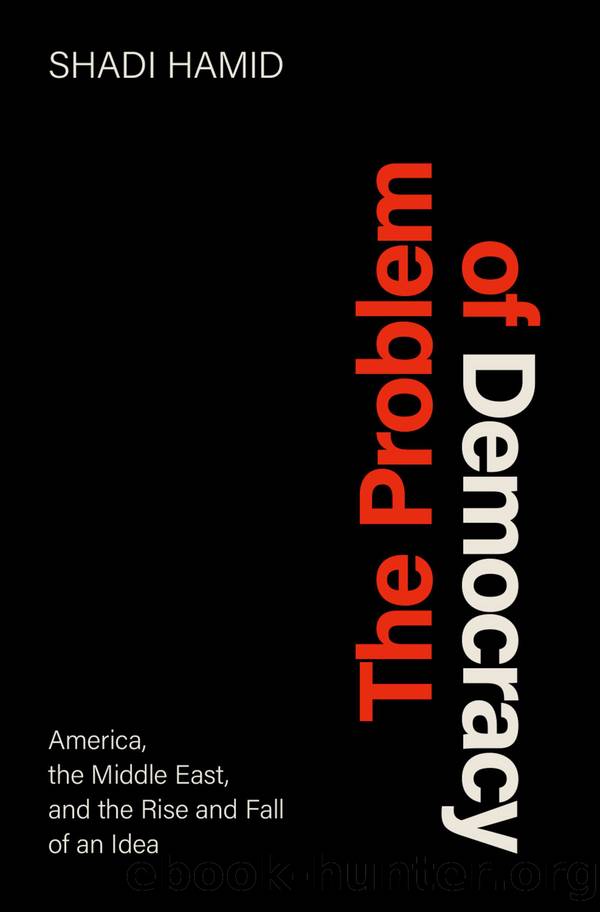
Author:Shadi Hamid
Language: eng
Format: epub
Publisher: Oxford University Press
Published: 2022-01-15T00:00:00+00:00
Obamaâs Lost Opportunity
As is probably clear by now, I am uncomfortable with the realities of what American policy is, what it has been, and what it will likely be for some time to come. There is a temptation to throw up oneâs hands in exasperation. I remember a friend in the democracy promotion community telling a group of us that, after having spent years meeting with executive branch and congressional staff, he had reached his limit. It is difficult, he said, to escape the conclusion that American policy in the Middle East is âvileââa series of morally indefensible acts, one after the other.
The notion that the United States might only be persuaded to support democracy if it can be assured that there wonât be too much of it is dispiriting. Those of us hoping to persuade policymakers adapt to this reality. So we tell American officials that even if Islamists do come to power, there will still be ways to restrict their room for maneuver within the context of democracy. We tell them that Islamist parties are more pragmatic than they may first appear. But what if Islamists were less pragmatic and would more aggressively challenge American interests? Would democracy be any less valid? If our belief in an idea is so contingent and provisional, then do we truly believe in it?
With the string of tragedies and after repeated disappointments, many of us have lowered our sights. There are small victories, to be sure. When the United States decides to put a temporary hold on a small portion of aid to a repressive regime, this is a success, but it is a success so minor and insignificant against the backdrop of world historical events.
This is why the Obama years proved devastatingâin a way that they werenât with Trump or George W. Bushâfor anyone holding out hope for a different approach to the Middle East. Generally, when a particular policy becomes entrenched, it becomes very hard to undo. The Arab uprisings came as an unexpected, exogenous shock, presenting a rare opportunity to shake American policy from its stasis and do something dramatically different. It is difficult to overstate just how unusual the 2011 Arab uprisings were. Mass discontent is a common enough feature of modern Arab societies, but that discontent only rarely translates into anything resembling a revolution. So when revolutions appear to be occurring, those who have the opportunity to shape them should realize that it may, quite literally, be a once-in-a-lifetime event.
This is what was lost. If there was just one time where the United States could have acted differently, this would have been it, a fork in the road for both America and the Arab world. In this sense, we shouldnâtjudge the Obama administration against the Trump administration and ask who was better. There is no doubt that President Obama took democracy much more seriously than his successor. But the more telling juxtaposition is one where we consider the unprecedented circumstances Obama found himself in and the possibilities before him.
Download
This site does not store any files on its server. We only index and link to content provided by other sites. Please contact the content providers to delete copyright contents if any and email us, we'll remove relevant links or contents immediately.
| Anthropology | Archaeology |
| Philosophy | Politics & Government |
| Social Sciences | Sociology |
| Women's Studies |
The Secret History by Donna Tartt(19096)
The Social Justice Warrior Handbook by Lisa De Pasquale(12191)
Thirteen Reasons Why by Jay Asher(8914)
This Is How You Lose Her by Junot Diaz(6890)
Weapons of Math Destruction by Cathy O'Neil(6282)
Zero to One by Peter Thiel(5804)
Beartown by Fredrik Backman(5759)
The Myth of the Strong Leader by Archie Brown(5510)
The Fire Next Time by James Baldwin(5450)
How Democracies Die by Steven Levitsky & Daniel Ziblatt(5219)
Promise Me, Dad by Joe Biden(5154)
Stone's Rules by Roger Stone(5088)
A Higher Loyalty: Truth, Lies, and Leadership by James Comey(4965)
100 Deadly Skills by Clint Emerson(4927)
Rise and Kill First by Ronen Bergman(4790)
Secrecy World by Jake Bernstein(4754)
The David Icke Guide to the Global Conspiracy (and how to end it) by David Icke(4720)
The Farm by Tom Rob Smith(4514)
The Doomsday Machine by Daniel Ellsberg(4491)
